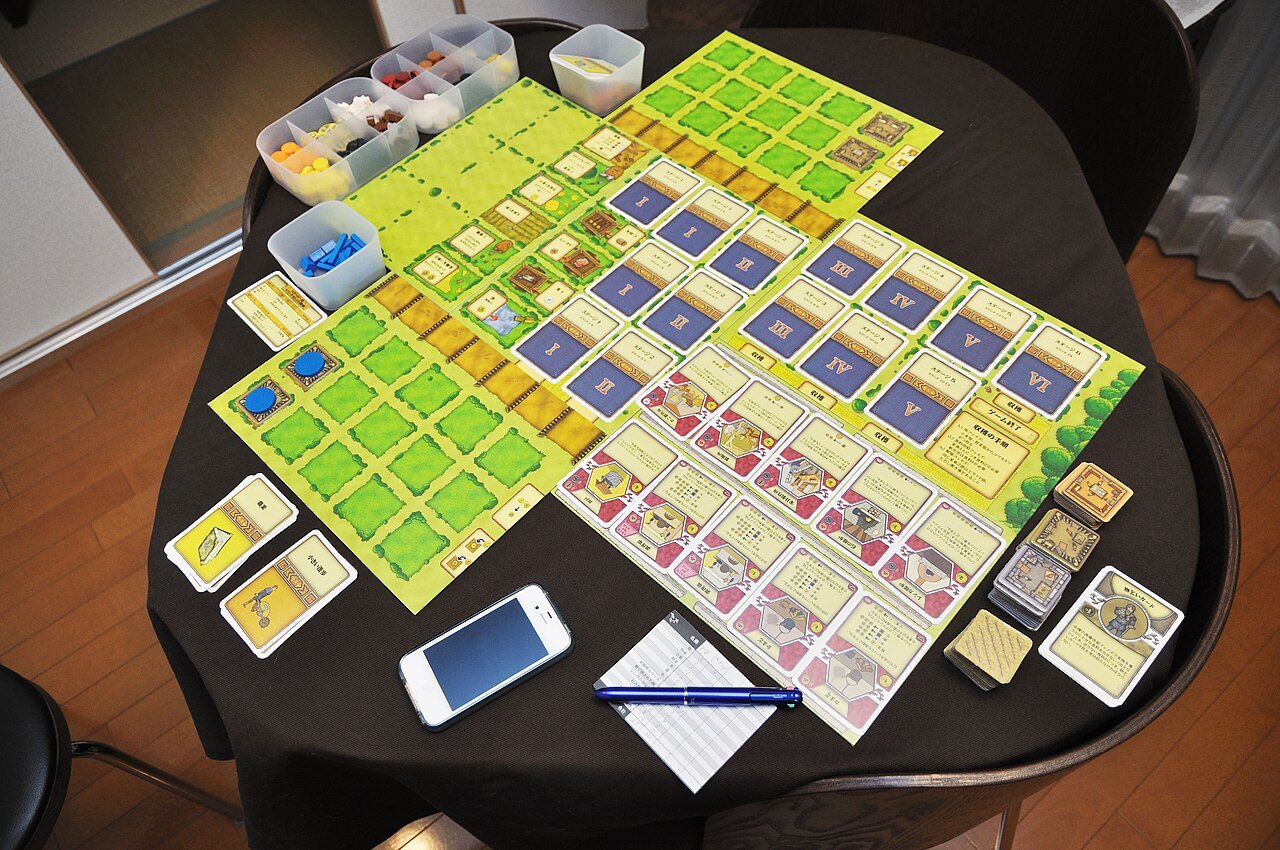

The board just fits, but once cards are dealt there is nowhere for anything else. A printed board accounts for only part of the space a game needs. Personal displays, shared supplies, discards and areas that grow during play also matter. On a small table, a trial setup should therefore consider the later state as well as the opening position.
Estimate the largest layout
Set out the board and starting components. Use spare cards or imagination to add areas that may expand. A tile-laying game needs free edges, while a card game may develop several rows in front of each person. Check whether players can still rest their hands comfortably and point to relevant information.
A game that fits only at the beginning rarely improves through increasingly dense stacking. Covered values and accidentally displaced cards can distort decisions. If necessary, choose a more compact game or a smaller variant explicitly provided by the rules. Reducing visibility is not an effective substitute for sufficient space.
Compact supplies without hiding information
Small dishes can contain shared tokens. Use shallow containers when quantity or colour must remain visible. Tall cups appear to save space but conceal information and make reaching pieces harder. Personal supplies should be combined only if doing so preserves ownership and any intended information boundaries.
A side table can hold unused components, rulebooks or drinks. Put active elements there only if everybody can see and reach them equally well. A remote display is otherwise easy to forget or can become unintentionally controlled by the person sitting nearest to it.
Check seating and lighting
Even a neat arrangement fails if someone can read small text only from an awkward angle. Turn personal boards appropriately and check the visibility of shared areas. An additional lamp should not create strong reflections on sleeved cards. Evaluate the actual seated positions rather than looking down from above.
Keep walking routes clear and avoid improvised table extensions that might tip. A small surface does not require less sociable play. A suitable choice of card games, dice games or compact boards often provides enough variety. The important point is that the complete game fits and nobody has to rearrange materials on every turn.