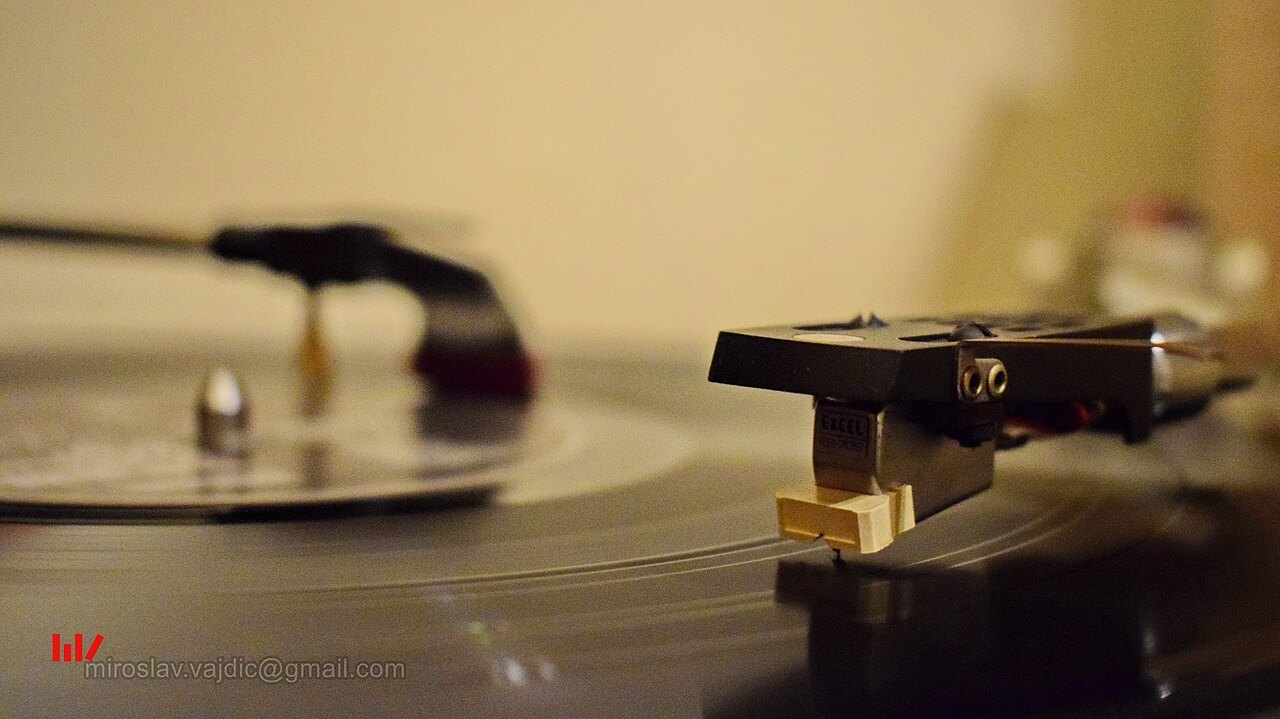

A crackling record can make quick household remedies tempting. An audible problem does not establish which treatment is appropriate, however. Dirt, static effects, wear or a playback issue can produce similar impressions. Begin by examining the record and the proposed method rather than mixing a liquid. Cleaning can remove deposits; it does not automatically restore damaged grooves.
Establish material and condition first
Not every black disc uses the same material. The Canadian Conservation Institute distinguishes vinyl, shellac and coated historical discs among other types. A product explicitly intended for vinyl is not thereby suitable for every other material. Resolve uncertainty about unusual discs before wet cleaning.
Inspect both sides under good light. Is there loose dust, visible handling residue or something firmly attached? Notice cracks and unusual flaking too. When condition is unclear, informed assessment may be more useful than repeated experiments. A rare recording is not a suitable test object for a method whose compatibility you do not know.
Understand the entire method
A purpose-made record brush can be used according to its instructions for loose surface dust. It does not automatically treat firmly attached contamination. With wet cleaning, fluid, application, removal and drying belong together. A solution intended for a vacuum machine cannot simply be treated as a polish to rub dry by hand.
Degritter's manual specifies distilled or demineralised water for its machine and warns against foaming additives. This is a device-specific instruction, not an invitation to substitute arbitrary household mixtures. Read the instructions for the actual system, including dilution and maintenance. More cleaning agent does not automatically produce better cleaning.
Do not judge remedies by reassuring names
Labels such as gentle or natural reveal little about compatibility with a groove, label or coating. Household products may contain additives not intended for this use. Avoid an unknown mixture merely because it worked on another surface. A small visible test at an edge also does not establish that the entire playing surface will remain unaffected over time.
Separate care of the machine from care of the record. A cloth or product suited to a casing need not suit the disc. Cleaning a delicate stylus is another distinct task with its own manufacturer guidance. One bottle for everything is not a useful organisational system.
Check the result coherently
Start with a record whose material and condition are known, and avoid changing several playback variables simultaneously. Afterwards, hear the same short passage at the same settings. If a noise remains, it does not automatically follow that harder rubbing or repeated washing is needed. The cause may lie outside the contamination being removed.
Return a cleaned disc to a clean inner sleeve only when fully dry according to the method used. Briefly note what has been done to a problematic record. This prevents a series of uncoordinated attempts. Good care also includes recognising a limit: when a treatment offers no clear benefit or creates a new concern, the next step is clarification rather than greater intensity. Keep the instructions with the cleaning equipment so that another household member can follow the same procedure without guessing.