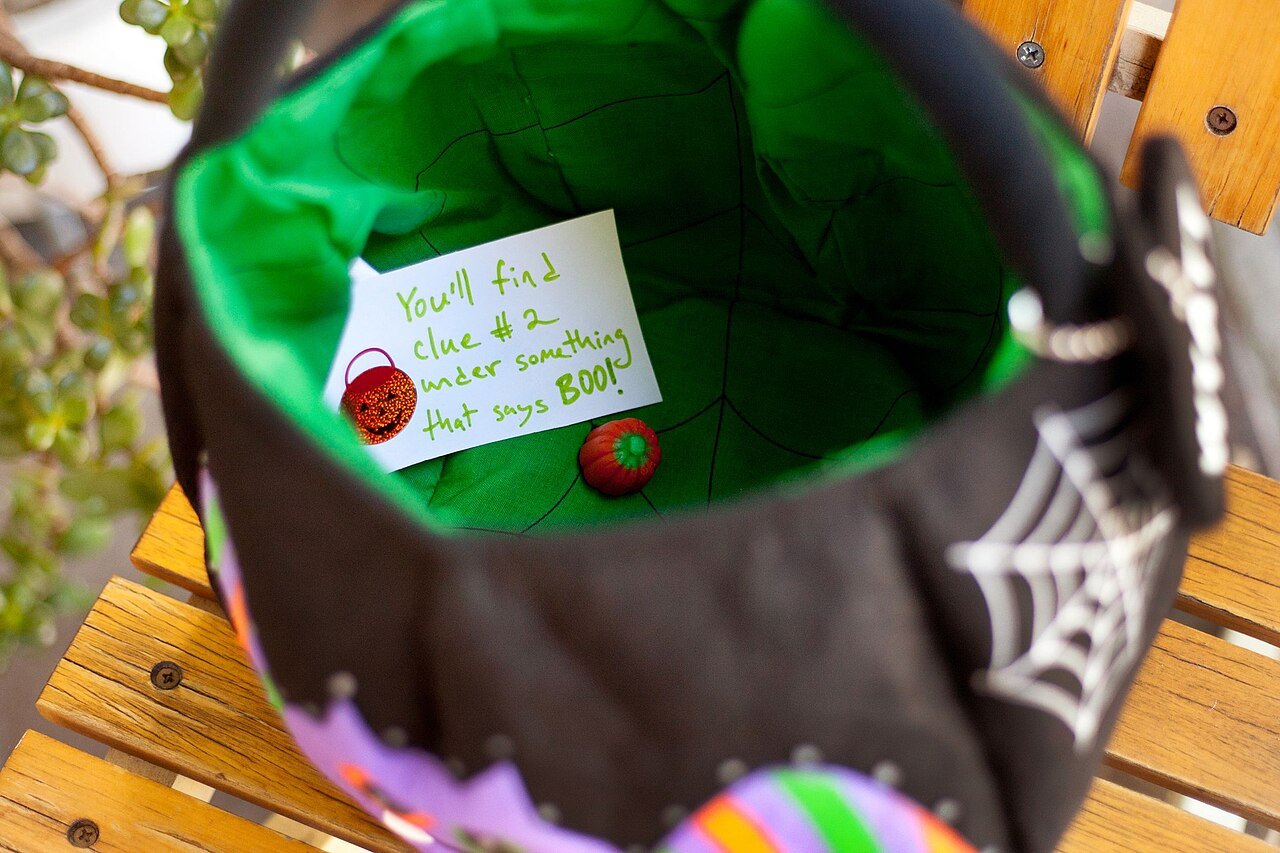

An indoor scavenger hunt does not need an elaborate treasure story. A few well-chosen clues can create a connected task. What matters is that players know which rooms are included and that every hiding place can be reached without risky movements.
Set the search area before writing clues
Choose accessible areas and explicitly exclude private drawers, fragile objects and unsuitable rooms. Do not hide anything around electrical equipment, in food or where furniture would need to be climbed. The task should be solvable through observation.
Responsible adults should plan boundaries and supervision when children take part. A clue can point to a visible object without requiring it to be moved. The home then remains a play space rather than becoming an unrestricted search area.
Plan a short chain backwards
Choose the ending first, perhaps an envelope containing a shared drawing task. Then select three or four earlier stations. Record which clue leads to each station and which clue is left there. This prevents a note accidentally pointing back to itself.
Write clues that suit the group. “Where we leave wet umbrellas” may be clear in a familiar home, while “somewhere cosy” is too open. Add a distinguishing feature when several answers are possible.
Test the whole sequence yourself and check whether a clue is accidentally visible from the starting place. Keep a copy of the answers. You can then give a focused hint when progress stalls instead of immediately revealing the destination.
Make it cooperative rather than a race
Let the group read and decide together. Roles such as reading, holding clues and noting answers can rotate. Multiple teams need separate or duplicated clues so that the first team does not remove the task for everyone else.
Collect every note afterwards. Ask which clue was clear and which was too vague. For another round, change the form deliberately, perhaps from text to image details, rather than simply choosing more difficult hiding places.