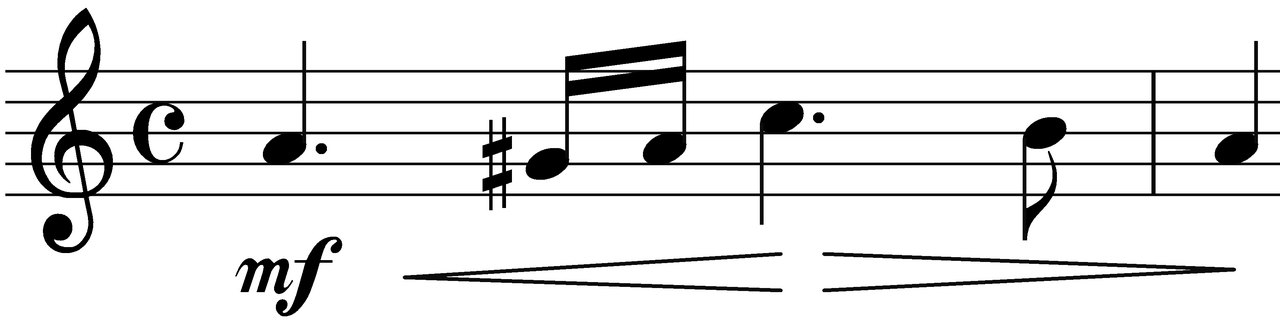
Quiet and loud passages can shape music as strongly as melody or rhythm. A gradual build creates different expectations from a sudden shared entrance. At the same time, dense sound is not automatically louder, and a quiet passage is not automatically calm. To hear dynamics more precisely, separate these impressions and keep the volume control unchanged through a suitable passage where possible.
Follow a change over time
OpenLearn describes a gradual increase in level as a crescendo and a decrease as a diminuendo. These can concern one note or a longer passage. Initially, ask whether the change is gradual or abrupt. A score is unnecessary for describing that progression.
Choose a restrained opening and notice when a build first becomes apparent and whether it continues. A climax may be prepared and then avoided. A clear break may occur where the preceding movement suggested continuation. The useful question is not only how loud, but when and in what context.
More instruments create another kind of change
Additional parts increase density. Loudness may also rise, but the two need not develop in the same way. At a denser moment, listen for individual voices simultaneously receding. A fuller impression can result from more things happening rather than everything becoming more prominent.
Conversely, one note after a dense passage can seem exceptionally clear. Contrast and available attention contribute to that effect. Describe the steps separately: the accompaniment stops, the voice remains alone, its entrance stands out. This need not become a claim about a measured increase in level.
Include the pause
A brief quiet interval before an entrance can alter its weight. Does the gap let a previous sound decay or create an abrupt interruption? The acoustic surroundings contribute: reverberation may remain after new notes have stopped. Musical silence does not always mean complete acoustic absence.
A simple thought experiment helps. The same strong chord feels different after continuous loud music than after a long quiet note. The chord alone cannot explain the effect. Include the lead-in when comparing a climax. An isolated extract can remove precisely the preparation that makes it significant.
Avoid changing playback unnoticed
Turning up every quiet moment and down every strong entrance changes the progression you hear. For concentrated listening, choose a comfortable base level that accommodates the stronger passages too. If that is impractical in the room, it is a real limitation of the situation rather than a personal failure to listen.
Check whether the device applies a feature that reduces level differences. This is not identical to uniform level adjustment between tracks. EBU loudness resources distinguish questions of programme loudness and its measurement; a single label such as normalised does not reveal an application's exact behaviour. Consult its description instead of assuming all volume-related functions do the same thing.
Describe the effect at an appropriate scale
After listening, record a relationship: the music becomes denser over several phrases, recedes and leaves the next entrance unexpectedly exposed. This describes a progression without equating density, loudness and tempo. When comparing another recording later, that passage can show which movement of tension remains and which changes.
Dynamics is not a competition for the largest possible contrast. Some pieces use small gradations, others marked oppositions. What matters is the relationship audible within the particular progression. A long even passage can also serve a purpose when its consistency makes the following change perceptible. Your account becomes useful when it identifies that relationship rather than simply praising wide dynamics or condemning restraint.