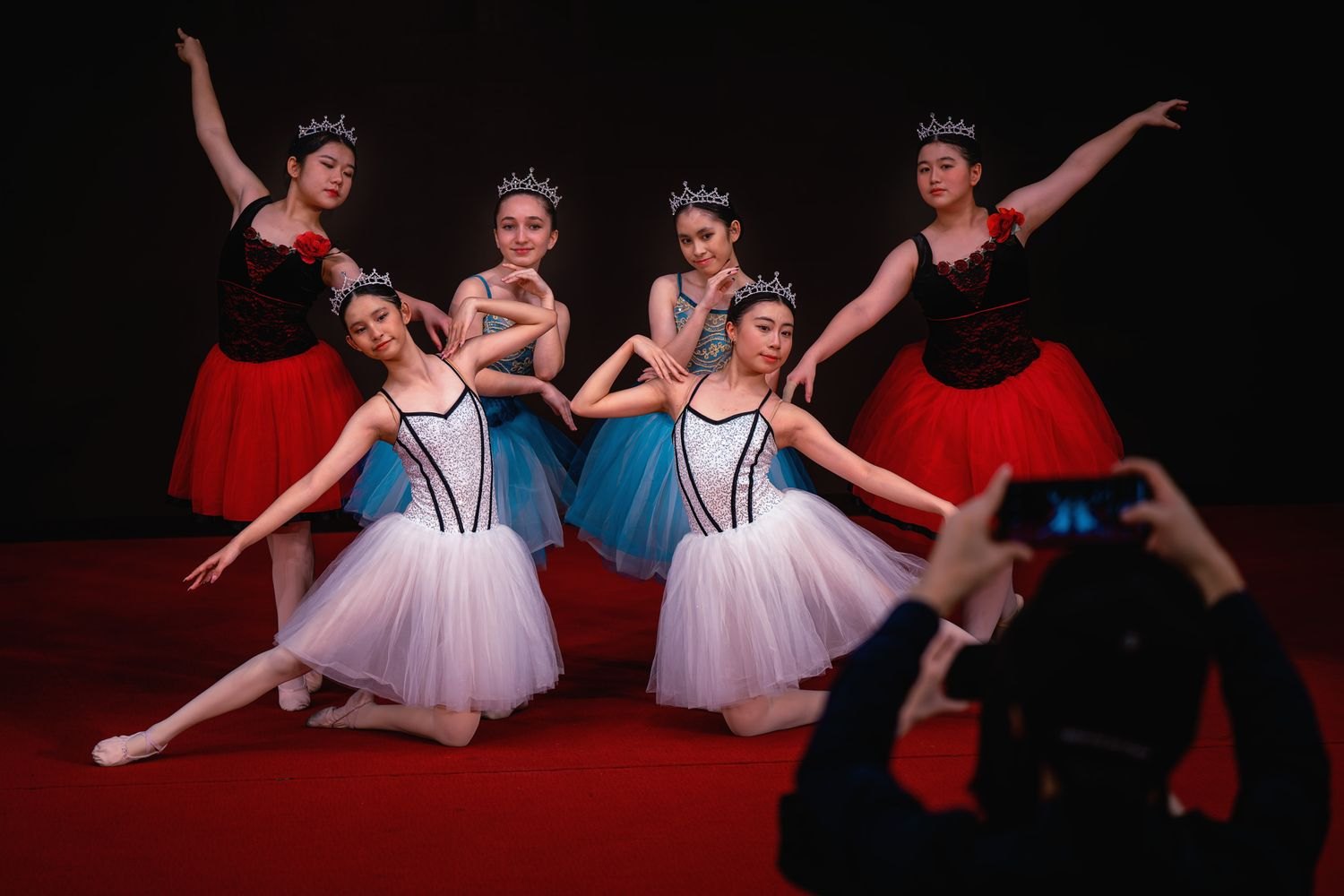
You can watch ballet without knowing the names of individual steps. Begin by following how bodies use space, how groups form and how movement responds to music. The production information can help establish whether a performance tells an identifiable story or works more through abstract forms.
Check the kind of programme
A full-length narrative ballet and a programme of several short choreographies call for different preparation. Check how many parts are announced and whether there are intervals. For a story ballet, an outline of the characters and initial conflict is often enough.
With a more abstract work, you do not have to search for a hidden plot. Instead, ask which movement pattern returns or when the group changes. Your own observation is a useful starting point even if it differs from an interpretation you read afterwards.
Shift your attention deliberately
Watch the whole stage for a while, then follow one person. The wider view reveals lines and spacing; closer attention reveals changes of direction and connections between two people. Both perspectives belong to the performance.
Notice whether movement coincides exactly with a musical accent or moves independently of it. Sudden stillness can be as striking as a fast passage. You do not need to judge a movement’s technical difficulty to describe its effect.
A concrete comparison helps afterwards: a group first stood close together and then spread across the stage. What atmosphere did that create? Such descriptions are more precise than assuming every step must have a fixed meaning.
Choose a seat for its perspective
For restricted-view seats, ask which part of the stage is affected. A position close enough to see faces clearly may offer a different overall impression from a higher view of formations. There is no universal ranking: the auditorium, production and your priorities all matter.
Take two or three precise impressions away from a first visit rather than trying to construct a complete explanation. At another performance, you can compare how differently choreographies use space, music and groups.